
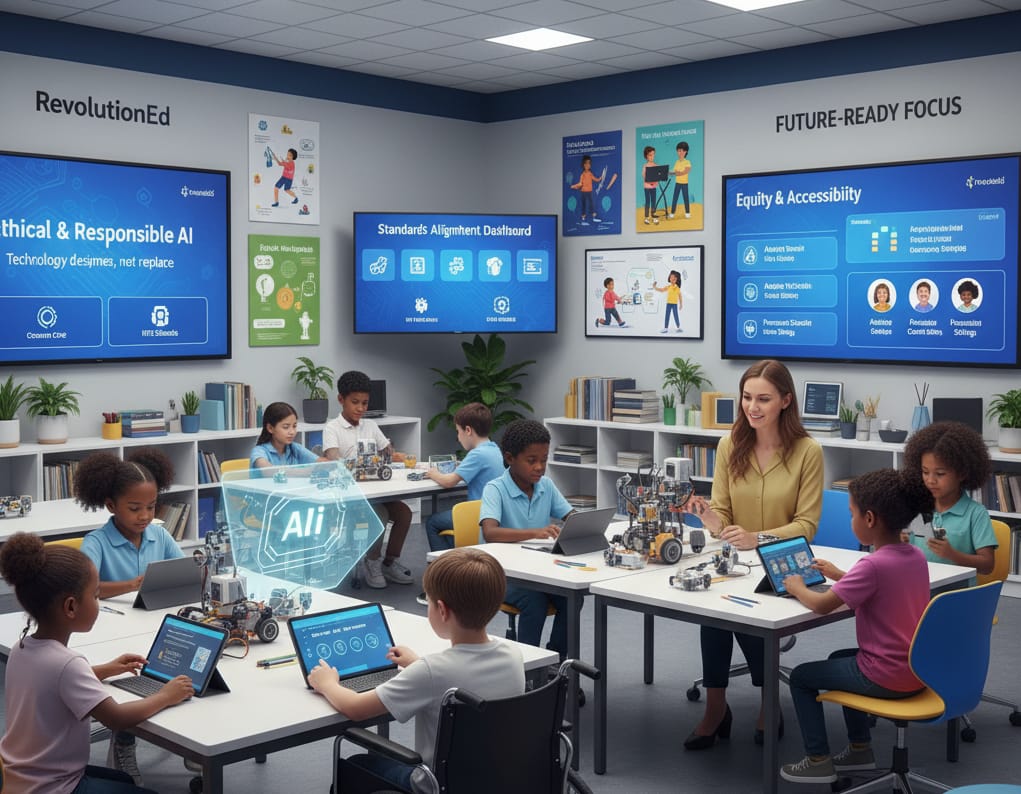
Educational leaders are navigating a moment of enormous possibility – and understandable caution. Artificial intelligence is everywhere, but not all AI is built for classrooms, and very little of it is built with teachers at the center.
That distinction matters.
Collaborative AI only works when teachers stay in the driver’s seat. When they are treated not as users of a tool, but as professionals whose judgment, expertise, and decision-making define the learning experience. When AI reduces friction instead of introducing it. When it supports the work educators already do best instead of attempting to replace it.
This belief is foundational to RevolutionEd.
AI Should Reduct Friction, Not Replace Judgment
RevolutionEd was built around a simple idea: AI should reduce friction, not replace professional judgment.
In too many conversations about technology, efficiency becomes the primary goal. Automation is positioned as progress, and speed is treated as a substitute for quality. But in real classrooms, learning does not improve simply because something happens faster. It improves when instruction is thoughtful, coherent, and responsive to students.
Teachers are already instructional designers. They make decisions every day about pacing, emphasis, materials, and support. Any AI that claims to help education must begin by respecting that reality.
RevolutionEd supports teachers as instructional designers and decision-makers. The platform does not dictate instruction or flatten professional expertise. Instead, it works alongside educators, helping them move from intention to implementation with less friction and more clarity.
That collaboration allows teachers to focus their energy where it matters most: on students.
Coherent Learning Experiences for Students
When teachers are supported rather than overridden, students benefit.
Students experience learning that feels connected instead of fragmented. Lessons build on one another. Expectations are clear. The work makes sense. Engagement increases not because content is flashy, but because it is coherent and purposeful.
RevolutionEd helps create learning experiences that are coherent, engaging, and revolutionary – not by chasing novelty, but by strengthening alignment. Alignment between what is planned and what is taught. Between instruction and assessment. Between individual classrooms and district priorities.
For students, this coherence matters. It shapes how they experience school, how confident they feel as learners, and how meaningfully they can engage with content over time.
Districts Building Systems, Not Chasing Trends
Districts using RevolutionEd are not chasing trends.
They are making deliberate choices to build systems where curriculum, instruction, and assessment actually connect. Systems where AI is not a standalone tool, but part of a broader instructional ecosystem. Systems that honor the complexity of teaching while reducing unnecessary obstacles.
This kind of system-building requires restraint. It requires clarity about what matters most. And it requires technology that strengthens existing work rather than pulling attention in a dozen different directions.
RevolutionEd is designed for districts that value coherence over chaos and sustainability over short-term wins. Districts that understand that real improvement comes from strengthening practice, not layering on more disconnected solutions.
Collaboration at Scale, Designed for Real Classrooms
This is not automation for its own sake.
Automation alone does not understand context. It does not see students. It does not adapt to the realities of classrooms. Collaboration does.
RevolutionEd represents collaboration at scale – between educators and technology, across classrooms and schools, and throughout districts. It is designed for real classrooms, where time is limited, expectations are high, and teachers are asked to do extraordinary work every day.
By keeping teachers in the driver’s seat, collaborative AI becomes a force multiplier rather than a replacement. It helps districts move forward together, with shared purpose and shared understanding.
A Different Vision for AI in Education
At its core, RevolutionEd reflects a different vision for AI in education.
One where teachers are irreplaceable.
One where students are supported through coherent, engaging learning experiences.
One where districts build connected systems instead of isolated tools.
One where progress is measured not by novelty, but by how well the system supports teaching and learning.
Collaborative AI only works when it is grounded in these principles. When it is designed to strengthen what already works. When it is guided by educators who understand their students and their communities.
That is the work RevolutionEd was built to support.
Request a live demo to see how teacher-driven AI can improve student outcomes without adding complexity: https://revolutioned.ai/demo/