
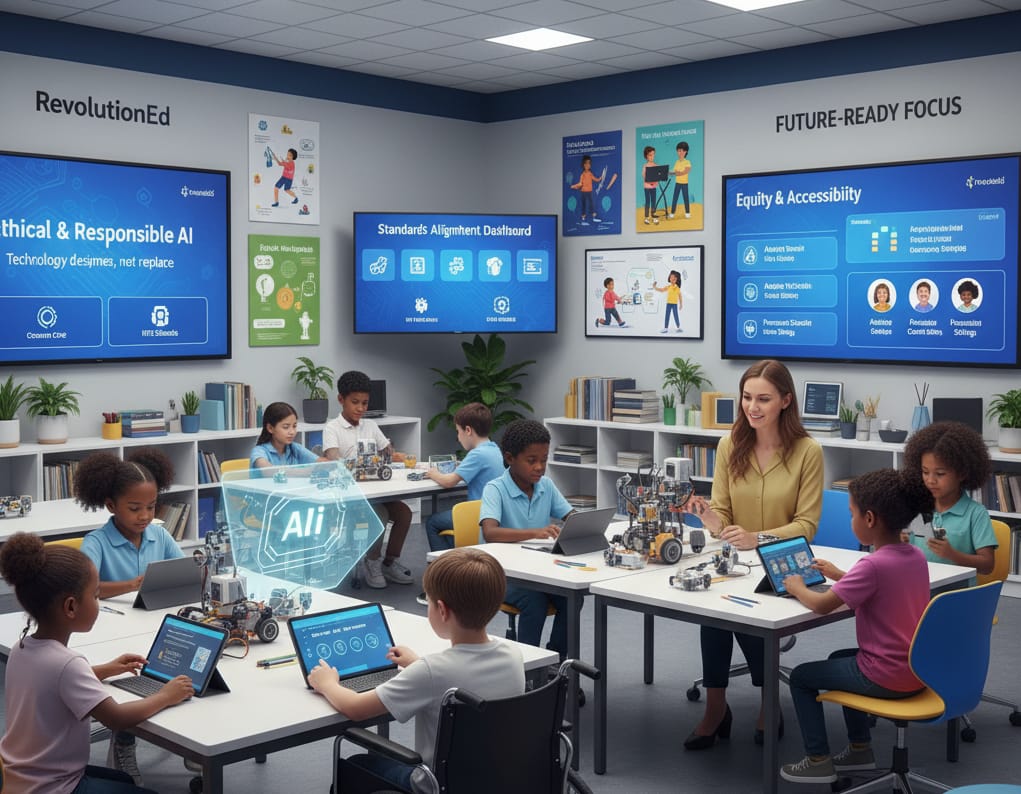
Collaborative AI. Teacher-Driven. Student Success.

Educational leaders are navigating a moment of enormous possibility – and understandable caution. Artificial intelligence is everywhere, but not all AI is built for classrooms, and very little of it is built with teachers at the center.

That distinction matters.

Collaborative AI only works when teachers stay in the driver’s seat. When they are treated not as users of a tool, but as professionals whose judgment, expertise, and decision-making define the learning experience. When AI reduces friction instead of introducing it. When it supports the work educators already do best instead of attempting to replace it.

This belief is foundational to RevolutionEd.

AI Should Reduct Friction, Not Replace Judgment

RevolutionEd was built around a simple idea: AI should reduce friction, not replace professional judgment.

In too many conversations about technology, efficiency becomes the primary goal. Automation is positioned as progress, and speed is treated as a substitute for quality. But in real classrooms, learning does not improve simply because something happens faster. It improves when instruction is thoughtful, coherent, and responsive to students.

Teachers are already instructional designers. They make decisions every day about pacing, emphasis, materials, and support. Any AI that claims to help education must begin by respecting that reality.

RevolutionEd supports teachers as instructional designers and decision-makers. The platform does not dictate instruction or flatten professional expertise. Instead, it works alongside educators, helping them move from intention to implementation with less friction and more clarity.

That collaboration allows teachers to focus their energy where it matters most: on students.

Coherent Learning Experiences for Students

When teachers are supported rather than overridden, students benefit.

Students experience learning that feels connected instead of fragmented. Lessons build on one another. Expectations are clear. The work makes sense. Engagement increases not because content is flashy, but because it is coherent and purposeful.

RevolutionEd helps create learning experiences that are coherent, engaging, and revolutionary – not by chasing novelty, but by strengthening alignment. Alignment between what is planned and what is taught. Between instruction and assessment. Between individual classrooms and district priorities.

For students, this coherence matters. It shapes how they experience school, how confident they feel as learners, and how meaningfully they can engage with content over time.

Districts Building Systems, Not Chasing Trends

Districts using RevolutionEd are not chasing trends.

They are making deliberate choices to build systems where curriculum, instruction, and assessment actually connect. Systems where AI is not a standalone tool, but part of a broader instructional ecosystem. Systems that honor the complexity of teaching while reducing unnecessary obstacles.

This kind of system-building requires restraint. It requires clarity about what matters most. And it requires technology that strengthens existing work rather than pulling attention in a dozen different directions.

RevolutionEd is designed for districts that value coherence over chaos and sustainability over short-term wins. Districts that understand that real improvement comes from strengthening practice, not layering on more disconnected solutions.

Collaboration at Scale, Designed for Real Classrooms

This is not automation for its own sake.

Automation alone does not understand context. It does not see students. It does not adapt to the realities of classrooms. Collaboration does.

RevolutionEd represents collaboration at scale – between educators and technology, across classrooms and schools, and throughout districts. It is designed for real classrooms, where time is limited, expectations are high, and teachers are asked to do extraordinary work every day.

By keeping teachers in the driver’s seat, collaborative AI becomes a force multiplier rather than a replacement. It helps districts move forward together, with shared purpose and shared understanding.

A Different Vision for AI in Education

At its core, RevolutionEd reflects a different vision for AI in education.

One where teachers are irreplaceable.

One where students are supported through coherent, engaging learning experiences.

One where districts build connected systems instead of isolated tools.

One where progress is measured not by novelty, but by how well the system supports teaching and learning.

Collaborative AI only works when it is grounded in these principles. When it is designed to strengthen what already works. When it is guided by educators who understand their students and their communities.

That is the work RevolutionEd was built to support.

Request a live demo to see how teacher-driven AI can improve student outcomes without adding complexity: https://revolutioned.ai/demo/ 

Connecting Students to Real-World STEM Careers

Ever heard a student ask, “When will I use this in real life?”

For decades, that question has reflected a deeper challenge in education: students often experience math, science, and technology as disconnected from the world beyond school. In today’s economy – where innovation, automation, and data touch nearly every career that disconnect has real consequences.

RevolutionEds, in partnership with JASON Learning (a global leader in research-driven STEM education), was built to address this challenge by helping districts connect classroom instruction to real-world STEM applications and career pathways.

The Challenge: STEM Learning Without Context

In many classrooms, students master content without understanding its purpose.

They solve equations without seeing how those same mathematical models drive data analysis, engineering, or artificial intelligence. They learn scientific concepts without understanding how those ideas translate into real-world problem-solving.

As a result, students may meet standards while still feeling unprepared for the future of work particularly in STEM fields that are evolving faster than traditional instructional models can adapt.

District leaders increasingly recognize that relevance, coherence, and career connection are no longer optional. They are essential to student engagement, persistence, and long-term success.

The RevolutionEd Approach: Research-Driven, Collaborative AI

RevolutionEd is a research-driven, collaborative AI-powered instructional platform designed to work with educators, not replace them.

Built on evidence-based instructional practices and informed by learning science, RevolutionEd supports districts in strengthening instructional coherence, improving literacy and STEM integration, and increasing the relevance of daily instruction.

Rather than prescribing a single teaching model, RevolutionEd equips educators with tools that support:

  • Standards-aligned lesson design
  • Student-level differentiation
  • Individualized learning pathways
  • Career-connected personalization

All while preserving teacher expertise and professional judgment.

Through its partnership with JASON Learning, RevolutionEd further extends real-world STEM relevance by aligning instruction to authentic scientific challenges, industry contexts, and future-facing careers.

1. Connecting Instruction to Real-World Contexts

RevolutionEd helps educators move beyond theoretical instruction toward learning grounded in real application.

Using collaborative AI-supported planning, teachers can design instruction that:

  • Aligns academic standards to authentic STEM applications
  • Demonstrates how math, science, and technology are used across industries
  • Adapts instruction to diverse learning needs while maintaining rigor

For example:

  • A physics lesson may center on real engineering constraints
  • A math unit may connect to financial literacy or data-driven decision-making
  • A science lesson may explore how technology supports environmental research

When instruction reflects how knowledge is actually used, students begin to see STEM as a set of tools for understanding and navigating the world, not just content to memorize.

2. Building Visibility Into STEM Career Pathways

Students don’t just need skills. They need clarity.

RevolutionEd supports educators in making career connections explicit by helping them align instruction with real-world roles in technology, engineering, data science, and emerging AI-enabled fields.

Through AI-informed instructional design, teachers can:

  • Highlight how classroom skills translate to future careers
  • Connect student interests and strengths to academic pathways
  • Build awareness of multiple STEM trajectories, not just a single outcome

This career-connected personalization helps transform curiosity into direction and increases student motivation by answering a critical question: Why does this learning matter?

3. Preparing Students for Skills That Endure

Technical knowledge alone is not enough.

The future workforce demands adaptable thinkers, students who can analyze, communicate, collaborate, and solve complex problems in unfamiliar contexts.

RevolutionEd supports districts in embedding these competencies into everyday instruction by helping educators design learning experiences that emphasize:

  • Critical and analytical thinking
  • Problem-solving and application
  • Communication and adaptability

These skills are developed intentionally, not incidentally, through coherent, research-aligned instructional design.

A District-Level Shift Toward Career-Ready Learning

STEM careers continue to grow faster than most other occupational sectors, yet many future roles have not even been defined.

Preparing students for that reality requires more than isolated tools. It requires a system-wide approach that connects standards, instruction, personalization, and career relevance.

By adopting RevolutionEd, districts move toward learning that is:

  • Personalized at the student level
  • Coherent across classrooms and schools
  • Grounded in research and real-world relevance
  • Designed to support teachers, not replace them

Preparing Students for the Future – Now

When districts invest in platforms like RevolutionEd, they signal a commitment to instruction that reflects the world students are entering, not the one that existed decades ago.

Because the future belongs to students who don’t just learn about STEM, but understand how it shapes the world around them.

Call to Action

Ready to strengthen STEM instruction with research-driven, career-connected learning?
Explore how RevolutionEd, in partnership with JASON Learning, supports districts in preparing the next generation of innovators.

Why Superintendents Can’t Ignore AI in Curriculum Planning

Let’s be real, Artificial Intelligence is no longer a futuristic concept in K-12 education. It’s here, shaping how teachers plan lessons, personalize learning, and measure outcomes.

But here’s the catch: while AI tools are already making their way into classrooms, district-wide curriculum planning hasn’t caught up. That’s where superintendents and district leaders play a critical role. Ignoring AI in curriculum design today means risking inequity, inefficiency, and irrelevance tomorrow.

The Wake-Up Call: AI Is Already in the Classroom

A 2024 Gallup and Walton Family Foundation survey found that nearly 60% of U.S. teachers now use AI tools to support lesson planning, grading, and communication, and they report saving an average of 5.9 hours per week on administrative work. That’s roughly six extra weeks of teaching time per year.

Imagine the impact if those time savings were built into district planning intentionally, not accidentally.

At the same time, the U.S. Department of Education’s 2024 report, Artificial Intelligence and the Future of Teaching and Learning, highlighted that AI-assisted instruction has “moderate but significant effects” on student performance, particularly in math and reading. In fact, meta-analyses show an average effect size between 0.36 and 0.42, equivalent to several months of additional learning gain in a school year.

The data is clear: AI isn’t just a trendy add-on, it’s a measurable accelerator of learning when implemented with purpose.

Why AI Must Be Part of Curriculum Planning?

1. Curriculum Now Extends Beyond Content

Traditionally, curriculum planning focused on what to teach – scope, sequence, and standards alignment.


In the AI era, it must also address how learning systems interact with data.

That means superintendents must ensure curricula:

  • Integrate adaptive learning tools that respond to student progress in real time.
  • Define data governance and interoperability standards (for SIS, LMS, and assessment systems).
  • Embed ethical AI use policies into curriculum frameworks to protect privacy and prevent bias.

Without these layers, schools risk fragmented pilots, vendor-driven chaos, and widening equity gaps.

2. Differentiation at Scale (Without Overwhelming Teachers)

Every superintendent knows the pressure teachers face to differentiate for multilingual, neurodiverse, and struggling learners. AI can lighten that load.

Tools like adaptive learning platforms and AI lesson generators can:

  • Provide personalized scaffolds for each student.
  • Auto-generate accommodations aligned with IEP or EL needs.
  • Offer real-time insights into student progress and engagement.

By leveraging these tools strategically, districts can scale differentiation, not just for one classroom, but across the district.

Fact: According to the RAND Corporation (2024), schools that integrated adaptive AI tools for reading and math interventions saw 10–15% higher growth scores than comparable schools using traditional approaches.

3. Data-Driven Decisions, Not Guesswork

AI brings a new advantage to curriculum design: continuous feedback loops.
Instead of waiting for quarterly benchmarks, superintendents can access dashboards showing:

  • Learning progress by standard
  • Real-time engagement data
  • Which interventions are working (and which aren’t)

This means curriculum teams can make agile, evidence-based updates mid-year, something nearly impossible with traditional systems.

4. Preparing Students for the AI Economy

The World Economic Forum estimates that by 2027, more than 50% of all employees will need reskilling due to AI automation. If K-12 doesn’t adapt its curricula, students will graduate unprepared for an AI-driven workforce.

Forward-thinking superintendents are now embedding AI literacy across subject areas, not as a standalone elective, but as part of digital citizenship, computational thinking, and career-readiness standards.

That’s not just innovation, it’s economic necessity.

The Challenges Superintendents Must Manage

AI isn’t without its risks. District leaders must actively address:

  • Data privacy & FERPA compliance: Ensure all tools meet federal and state student data protections.
  • Algorithmic bias: Vet AI tools for equitable outcomes, especially for multilingual and neurodiverse learners.
  • Assessment integrity: Redesign evaluation systems to measure learning process and creativity, not just written output.
  • Teacher training gaps: Build professional development that helps educators critically use, not fear, AI.

As the U.S. Department of Education notes, “AI in education must augment, not replace, human judgment.” Leadership determines whether that balance is achieved.

A Framework for Action: What Superintendents Can Do Now

Here’s a practical, district-ready roadmap to start integrating AI into curriculum planning:

  1. Form an AI Curriculum Task Force – Include curriculum leaders, IT, special education, teachers, and parent reps.
  2. Pilot Purposefully – Choose 3-4 use cases like adaptive math, AI lesson planning, or multilingual writing support.
  3. Create Vendor Standards – Demand transparency in AI models, data practices, and accessibility compliance.
  4. Invest in PD – Train teachers in AI literacy, bias detection, and safe classroom integration.
  5. Redesign Assessment Policies – Teach students to disclose AI use and evaluate both process and product.

“The goal isn’t to automate teaching – it’s to elevate it.”  – Dr. Jen Walczak

Measuring Success

Success with AI integration goes beyond adoption rates. Superintendents should track:

  • Teacher time saved per week
  • Student growth in target subjects
  • Equity impact (e.g., narrowing achievement gaps)
  • AI literacy development among students and staff
  • Policy compliance (data and ethics)

Leadership Determines the Future

AI will not wait for district readiness. The question isn’t if it will shape learning, but who will shape how it’s used.

Superintendents have the authority and responsibility to lead this transformation ethically, strategically, and equitably.


Ignoring AI in curriculum planning today risks widening opportunity gaps tomorrow.

The next generation of curriculum isn’t just standards-aligned but it’s AI-aligned.


And the leaders who act now will define what high-quality, future-ready education looks like for the next decade.